
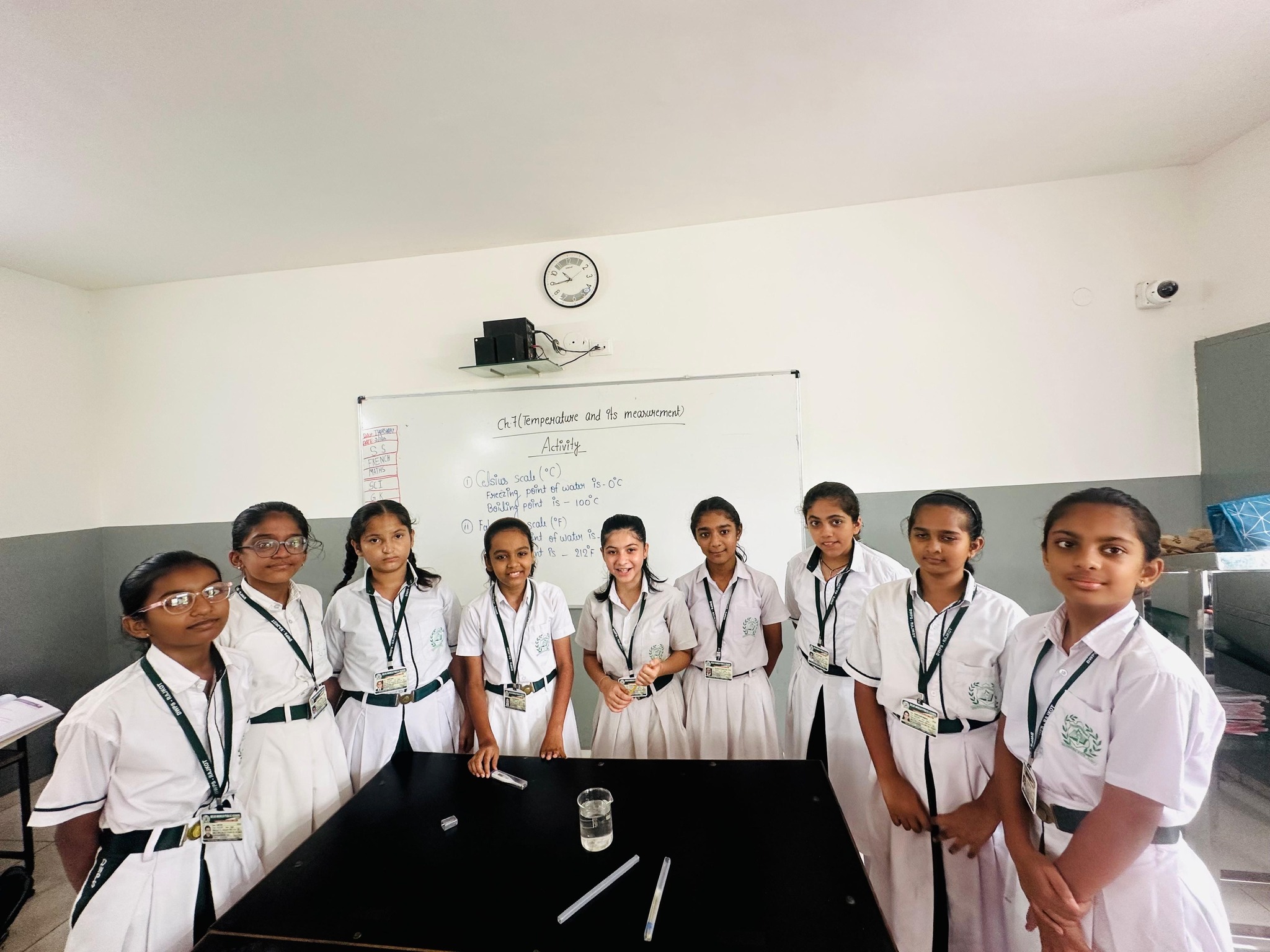
To promote experiential learning and make science education more hands-on and meaningful, a science activity on “Temperature and Its Measurement” was organized by the science teacher. The activity aimed to help students understand the concept of temperature, types of thermometers, and real-life methods of measuring temperature through direct observation and experimentation.
2. Learning Objectives
- To define temperature and understand its significance in daily life.
- To identify different instruments used to measure temperature (clinical thermometer, laboratory thermometer, digital thermometer, etc.).
- To develop skills in recording and interpreting temperature readings.
- To understand temperature scales – Celsius, Fahrenheit, and Kelvin.
- To encourage scientific observation, inquiry, and teamwork.


3. Strategies Used by the Teacher
- Interactive Demonstration: The teacher first explained the concept using charts and real thermometers. A clinical and a digital thermometer were demonstrated.
- Group Activity: Students were divided into small groups and provided thermometers to measure the temperature of different objects (cold water, warm water, body temperature, room temperature).
- Hands-On Experimentation: Each group recorded their findings and compared temperature readings using different thermometers.
- Discussion and Reflection: A group discussion was held where students shared their observations, errors, and learning.
- Use of Multimedia: Short videos on how thermometers work and historical background of temperature scales were shown to reinforce understanding.
4. Learning Outcomes
- Students were able to accurately use thermometers and record temperatures in Celsius and Fahrenheit.
- They developed an understanding of how temperature affects everyday life (weather, cooking, health).
- Students improved observational and analytical skills through hands-on practice.
- Learners became more confident in working collaboratively and reporting scientific data.
- Students could differentiate between various temperature-measuring instruments and their specific uses.
5. Conclusion
The activity successfully promoted experiential learning, enhancing both conceptual clarity and practical application. Students showed enthusiastic participation and expressed a better understanding of the topic. Such activities foster curiosity, deeper engagement, and long-term retention of scientific knowledge.
“Temperature and Its Measurement” a science activity to promote experiential learning
“Temperature and Its Measurement” a science activity to promote experiential learning
Principal
Rajeev Ranjan


Leave a Reply